Ten years ago the answer in Phoenix was easy: buy an AC and let a small gas furnace handle the handful of cold mornings each winter. Today, with heat pump efficiency ratings up sharply, natural gas prices volatile, and both federal and utility rebates favoring heat pumps, the calculus has flipped for a large share of Valley homes.
Key takeaways
- For all-electric Phoenix homes, heat pumps are now the default recommendation.
- Summer performance is identical to a matching-SEER2 AC.
- Winter operation costs less than a gas furnace and eliminates the gas meter charge.
- Federal 25C credit plus APS/SRP rebates can cut $3–5k off installed cost.
What a heat pump actually is
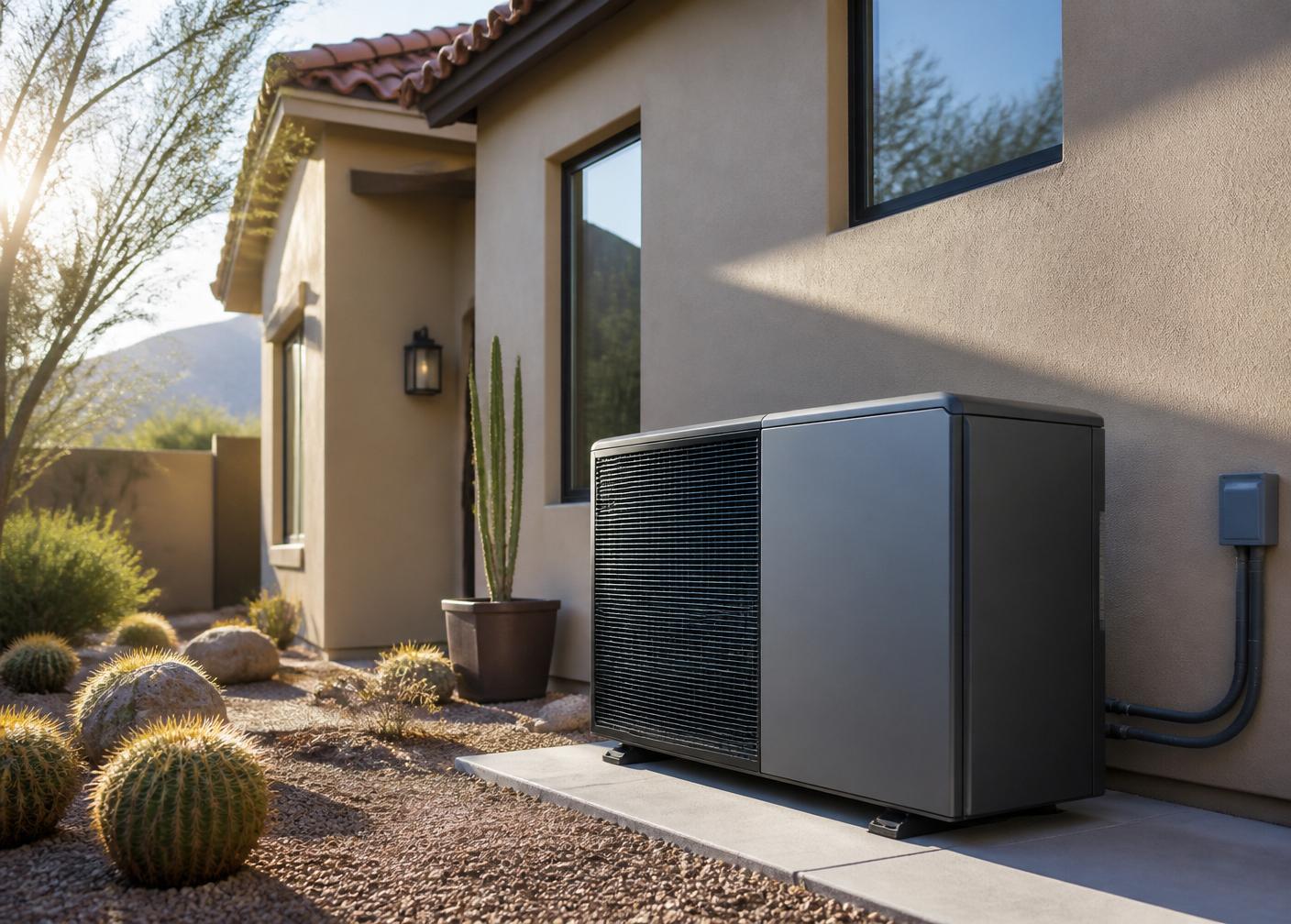
A heat pump is an air conditioner that can run in reverse. In summer it pulls heat out of your house and dumps it outdoors — exactly like your current AC. In winter it does the opposite, pulling heat from the outdoor air and delivering it into your home. No combustion, no gas line, one outdoor unit.
In Phoenix — where the coldest week of the year averages 40°F, well within the efficient operating range of any modern heat pump — the technology is a nearly perfect fit.
Efficiency and operating cost in the Valley
A modern 16 SEER2 heat pump cools essentially identically to a 16 SEER2 AC — same compressor family, same refrigerant, same electric bill for the summer.
The difference shows up in winter. Instead of burning gas at 80 to 96% efficiency, a heat pump delivers roughly 300% efficiency (a COP near 3) in Phoenix winter conditions — meaning 1 kWh of electricity moves about 3 kWh worth of heat into your home. For a typical Valley home the winter heating bill drops noticeably compared to gas, and there is no standing gas meter charge.
When an AC + furnace still makes sense
Two situations still favor the traditional setup: you already have a functional gas furnace under 10 years old and only need to replace the AC, or you have very cheap natural gas service and want to keep it. Otherwise, if you are replacing both sides of the system, the heat pump wins on nearly every dimension.
Rebates and tax credits available in Arizona
The federal Energy Efficient Home Improvement Credit (25C) offers up to $2,000 back on a qualifying heat pump installation. APS and SRP both run seasonal rebate programs for high-efficiency heat pumps — check current amounts before signing a contract. In many Valley homes the stacked incentives cut $3,000 to $5,000 off the installed price.
Rebate programs change; always confirm current qualifying SEER2 and HSPF2 ratings before purchasing.
Cost comparison — installed
A 3-ton 15.2 SEER2 central AC with a matched 80% gas furnace installs in most Valley homes for roughly $9,500–$13,500 depending on ductwork condition. A comparable 15.2 SEER2 heat pump with electric air handler installs for $10,000–$14,500.
Sticker price is roughly a wash. Once rebates apply and you subtract 10+ years of gas standing charges, the heat pump comes out clearly ahead for most homes.
What about dual-fuel?
A dual-fuel system pairs a heat pump with a gas furnace as backup — the heat pump handles most days and the furnace kicks in only when it is truly cold. In Phoenix that backup is rarely, if ever, needed. Dual-fuel makes sense at higher elevations (Prescott, Flagstaff) but not in the Valley.
Frequently asked questions
Does a heat pump work when it's 115° outside?
Yes. In cooling mode a heat pump is an air conditioner, engineered and tested to identical performance specs. Phoenix summer performance is not a concern.
Will a heat pump keep my house warm in a Phoenix winter?
Easily. Phoenix winter design temperatures sit well within the efficient operating band of every modern heat pump. Backup electric strip heat is typically included but rarely needed.
Are heat pumps louder than ACs?
No — a modern variable-speed heat pump often runs quieter than a 10-year-old single-stage AC because it spends most of its time at low speed.
Related services